
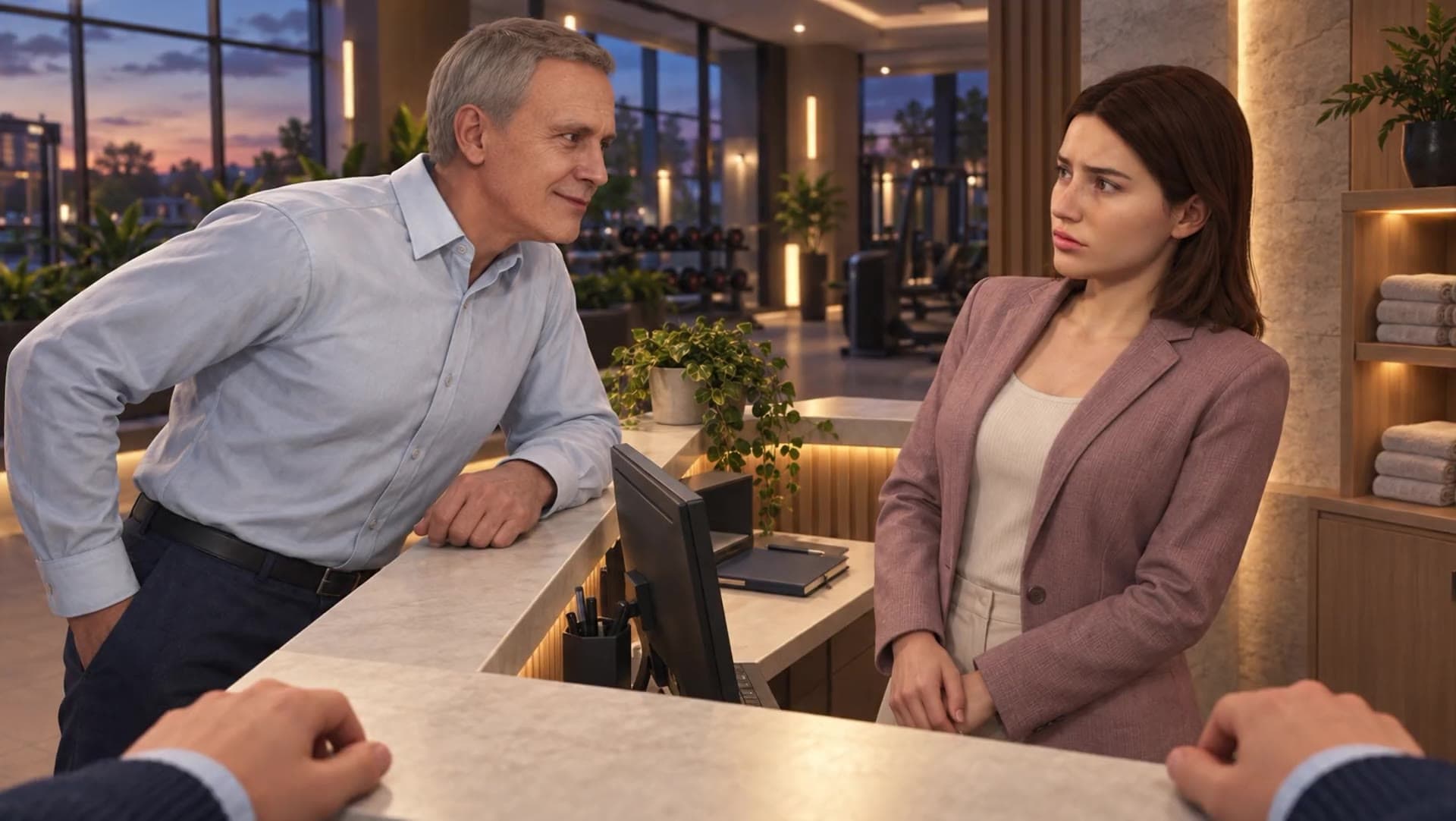
You were on the front desk.
UK employers must now prevent sexual harassment, and from 30 October 2026 the duty becomes stricter. Kiin trains people in the moments that lead to claims, and shows you whether behaviour changed.
Dan, a trainer who rents space at the gym, made a comment about Mia’s top. You were standing next to her.
Now the same thirty seconds from where Mia was standing.
Phone for everyone. VR for the few.
Everyone plays short cases on their phone. About one person in ten also goes into VR, inside the other person’s body. You choose who.
Both are measured, and the results come to you as one report by team.
The law now requires prevention.
- 01
Prevention is required
Since October 2024 you must take reasonable steps to prevent sexual harassment. Handling complaints well afterwards does not meet the duty.
- 02
Stricter from 30 October 2026
The duty becomes all reasonable steps, and you become liable for harassment by customers and other third parties.
- 03
Higher awards
A tribunal can add up to 25% to compensation if the duty was breached.
- 04
A safety duty too
In Australia every state and territory now requires employers to manage psychosocial hazards such as bullying and harassment. ISO 45003 gives the guidance.
A controlled study, measured two weeks later, based on behaviour cited in real lawsuits.
The energy company’s pilot in Mexico was set up as a study, with a control group, and measured two weeks later. The scenarios were built from behaviour cited in real court cases.
Three levels of measurement
- Self-reportedWhat people say afterwards.
- Observed in VRWhat they do in the scenario, such as where they look.
- Observed at workChange in your own HR data, usually from six months.
The figures above include one reported to us by the client. It is not part of the controlled study.
How the study worked
- 01
They were the bystander, then the victim
Participants lived a harassment scenario as the bystander, then went back into the same moment inside the victim’s body and watched their own earlier behaviour from her point of view.
- 02
Two weeks passed
Nothing was measured on the day. Participants returned a fortnight later to a fresh simulation and had the chance to intervene as a bystander.
- 03
Against a control group
A second group ran the same test having never had the victim perspective, alongside an untrained group. The difference between them is the effect.
- 04
Behaviour was measured
Where people looked and for how long, hand and body movement, and machine-scored analysis of what they said, analysed with classical and Bayesian statistics. This was recorded for the study with the client’s approval and each participant’s consent.
A global energy services company · three sites, Mexico · Nov–Dec 2023209 VR sessions · 250+ participants · 150 full data sets · 12 working days · 3 sites
Evidence of what changed
A report by team shows how people responded before and after the training. It holds no records on individuals.
Shown by team and by situation. No individual is identified.










Kiin was founded by Mel Slater, Mavi Sanchez-Vives and Bernhard Spanlang. Their peer-reviewed research showed that being in a virtual body changes how people behave afterwards.
“An excellent way to simulate situations we sometimes find hard to deal with. It is important to keep doing this, above all on sensitive subjects, to train people in how to handle them.”
See what your people would do.
Thirty minutes with us. Bring the training evidence you hold now and we will show you what Kiin adds.